Pillar 1: End-to-End AR Automation From invoice delivery to cash application, every step of the receivables cycle runs automatically. No spreadsheets. No manual chasing.
Pillar 2: Fully Built Into Your Existing System Centime lives inside NetSuite, Sage Intacct, and QuickBooks rather than sitting on top of them as a separate tool. Invoices sync the moment they are created. Payments post back automatically. You never have to leave your system to chase a payment.
Pillar 3: Customizable Workflows for Every Customer Configure collections sequences by risk tier, payment terms, aging bucket, dispute status, or autopay enrollment. Your best customers get a different experience than your past-due ones.
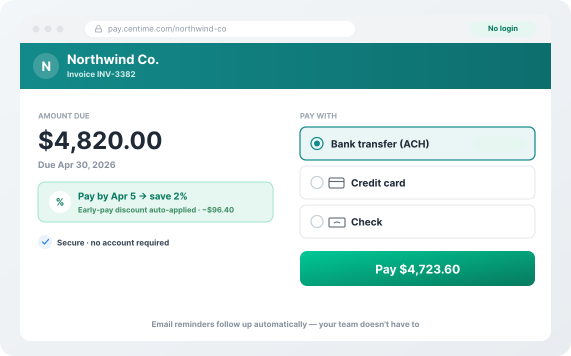
Pillar 4: One-Click Payment for Your Customers A branded, no-login-required payment portal makes it effortless for customers to pay by ACH, card, or check, directly from the email they already received.
Pillar 5: Reduce DSO. Measurably. Customers report cutting AR labor from 4–6 hours per week to under 1 hour, converting 50% of customers to electronic payments, and seeing a substantial decrease in overdue invoices.
Pillar 6: Live in as Little as 7 Days Most mid-market teams are fully up and running within one to three weeks. Dedicated ERP specialists handle the technical setup for you. No 3-month enterprise implementation. No open-ended timelines. You set your workflow rules, we handle the rest.
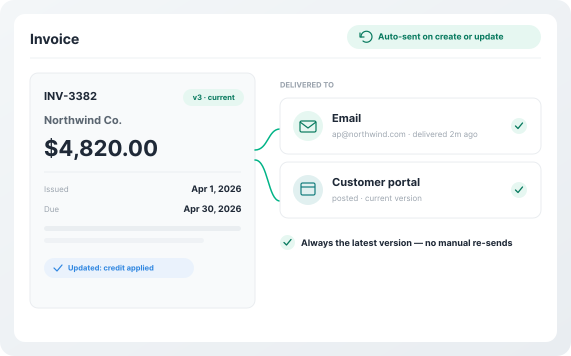
Centime detects new and updated invoices in your ERP within minutes and delivers them to your customer automatically, via email, customer portal, or both. Each delivery includes a direct payment link so customers can pay by ACH, card, or check with a single click. No manual export. No PDF attachments to compose. No delay between invoice creation and customer receipt.
When Centime pulls an invoice from your ERP, it captures everything on it, not just the total amount due. That means the full header: invoice number, invoice date, due date, PO number, customer name and billing address, currency, and payment terms. And every line item: descriptions, quantities, units of measure, unit rates to up to 6 decimal places (important for companies with high-precision billing), line-level amounts, tax codes, tax amounts, and memo or reference fields. Subtotals, discounts, and total amounts due carry forward exactly as they exist in your system. No rekeying. No rounding.
One thing worth knowing about invoice numbers specifically: each ERP has its own character limits for this field. QuickBooks Online caps the invoice number at 21 characters, and QuickBooks Desktop limits it to 11. NetSuite uses a sequential auto-generated format with configurable prefixes. Sage Intacct accommodates longer alphanumeric identifiers. Centime syncs whichever format your ERP produces and renders it accurately on the delivered PDF and in the customer portal, so your customer always sees the same invoice number that appears in your books.
If a delivery bounces or the contact address is stale, Centime flags it immediately for your team to correct. Every delivery (sent, opened, failed) is logged per invoice and per customer.
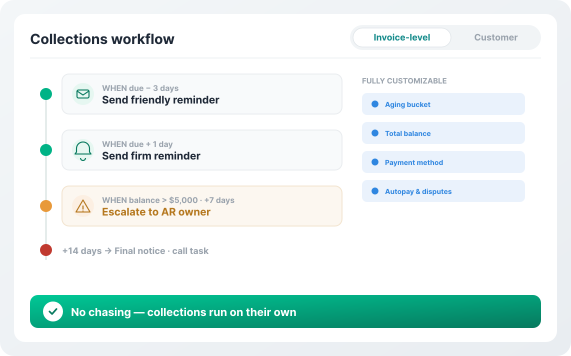
Most AR teams follow up on overdue invoices inconsistently. Someone is out, or the backlog is too big, or a high-value account gets attention while a smaller one quietly ages. Centime fixes this by running your collections process on a set of configurable rules that respond automatically to what is actually happening with each customer account.
You define the logic once: trigger conditions (days past due, outstanding balance, risk tier, whether the customer is on autopay, whether a dispute is open), and the actions that follow (send a reminder, assign an internal task, escalate to a manager, trigger a credit hold in NetSuite or Sage Intacct). From there, the system executes consistently across every account, every day, without requiring your team to manually decide what to do next. When a customer pays or opens a dispute, the workflow responds accordingly and without a manual restart. The "intelligence" here is not a black box: it is your own judgment, codified into rules that run at scale.
Think about the last collections email your team sent. Was it a generic "please remit payment" template from your ERP? Did it include the specific invoice the customer owed on, a direct link to pay, and your company's branding? Most do not. Centime's collection campaigns let you build the kind of email sequences that actually get opened and acted on.
Your collection workflows determine when to reach out. Collection campaigns determine how. Build branded email sequences, from a polite pre-due reminder to a firm final-notice escalation, each with its own tone, timing, and template. Every email pulls the customer's specific invoice details, outstanding balance, and a direct one-click payment link from your ERP automatically. No manual personalization required.
Campaign performance is tracked at the email level: open rates, click-to-pay rates, and average days-to-pay per campaign are all visible in the AR dashboard. If one subject line outperforms another with your 60-day-past-due segment, you will see it. Your team can refine what works by customer type over time.
Provide a secure, branded portal where customers can view their full invoice history, download PDFs, and pay open balances, with no account creation required. Customers access the portal with one click from the email they already received. Payment methods accepted: ACH, credit card (with compliant surcharge pass-through if configured), and check. Early payment discounts are applied automatically when configured.
Dispute management is available in the portal: customers can raise issues directly, triggering a notification to your AR team with full context attached. Every portal interaction is logged and visible to your team in real time.
Cash application is the step most AR teams dread: a payment arrives by ACH, wire, or check, and someone has to figure out which invoice it belongs to, key it into the ERP, and mark the invoice paid. When remittance information is missing or partial (which it often is), this becomes a research project. Centime automates it.
For payments processed through Centime Merchant Services, cash application is fully automatic. The payment is matched to the customer record and applied to the correct invoice in real time, then posted back to your ERP without any manual entry. For ACH, wire, and check payments, remittance files can be uploaded to automate matching without spreadsheet reconciliation. The goal is simple: a customer pays, and your books reflect it immediately, with no one in the middle.
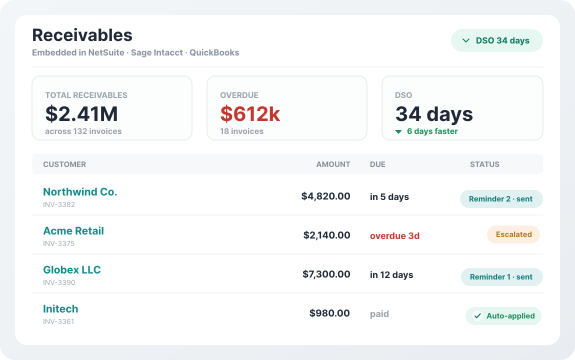
The Centime receivables dashboard gives AR managers and controllers real-time visibility into the metrics that actually drive decisions: total outstanding AR by aging bucket (current, 1–30, 31–60, 61–90, 90+ days), invoices flagged for follow-up by workflow status and risk tier, DSO trending month-over-month and by customer segment, and email delivery and payment conversion rates by campaign. Because Centime is connected to your AP pipeline and cash forecast, AR collections activity updates your projected cash position in real time.
For companies still receiving a significant volume of check payments, Centime's AR Lockbox automates check deposit and remittance processing. Checks are deposited daily, remittance data is captured and synced to your ERP automatically, and your balances earn interest while they're being processed. This eliminates the manual handling, data entry, and deposit delays that come with a traditional check-heavy AR process.
Centime handles credit card surcharge compliance at the global level and at the individual customer level. Configure surcharge rates by state (compliant with state-by-state surcharge regulations), waive surcharges for specific customers, and set maximum surcharge caps.
Surcharge amounts are disclosed to customers at the point of payment, generating a compliant, auditable record for every transaction.
Here is a fair way to think about how Centime works: it does not predict which customers will pay late using a machine learning model. What it does is take the judgment your best AR manager already carries in their head, which accounts need a gentle nudge versus a firm escalation, which disputes need to pause outreach, which payment promises need a follow-up if the date passes, and converts that judgment into a set of rules that run automatically across every account, every day, without anyone having to manually decide what to do next.
The result is a collections process that is consistent where human-managed processes are not. Your top accounts do not get special attention because someone remembered to call them. Your at-risk accounts do not slip through because your AR manager was on vacation. Every invoice follows the same logic, on the same schedule, and exceptions (disputes, payment promises, credit holds) are handled exactly as you configured. Whether you are managing 50 accounts or 5,000, the workload on your team stays roughly the same.

Centime doesn't stop at AR automation. It unifies receivables, payables, cash forecasting, and treasury in one ERP-embedded platform, built for mid-market teams running NetSuite, Sage Intacct, or QuickBooks. Every payment collected through AR updates your cash forecast automatically. Every invoice approved through AP reduces your forward cash position in real time. Your controller has a single source of truth for cash, not a spreadsheet stitched together from three separate tools.


Your ERP's AR module is a ledger. It records invoices when you create them and records payments when you post them. What it does not do is send those invoices to your customers automatically, follow up when they have not paid, give customers a way to pay online without calling your office, or match the payment back to the invoice without someone manually entering it. That gap between "invoice created" and "payment received and reconciled" is what AR automation software fills.
Centime automates every step in that gap: invoice delivery to the customer the moment it is created in your ERP, collections follow-up sequences that run on a schedule you define, a payment portal your customers can use without creating an account, and cash application that posts payments back to your ERP automatically. Your ERP stays the system of record. Centime handles execution.
Centime is a certified NetSuite SuiteApp, operating as a native embedded module within the NetSuite UI with real-time bidirectional sync. For Sage Intacct, Centime connects via API with support for multi-entity structures, dimensions, and real-time invoice sync. For QuickBooks Online and Desktop, Centime syncs invoices, customer records, and payment postings bidirectionally.
In all three ERPs, Centime reads the full invoice object on creation or update. On the NetSuite side this includes: tranid (invoice number), entity (customer), trandate (invoice date), duedate, amount, amountremaining, currency, terms, memo, department, class, and all item sublist fields including item, description, quantity, units, rate (to 6 decimal places), amount, and taxcode. Sage Intacct equivalents include INVOICENO, CUSTOMERID, WHENCREATED, WHENDUE, TOTALDUE, CURRENCY, TERMNAME, and line-level DESCRIPTION, QUANTITY, UNIT, UNITPRICE, and AMOUNT fields. QuickBooks surfaces the DocNumber (capped at 21 characters in QBO), CustomerRef, TxnDate, DueDate, Line objects with Description, Qty, UnitPrice, and Amount, and TxnTaxDetail for tax data.
Payments collected through Centime are posted back to the correct invoice and customer record automatically, with no manual ERP entry. See AR for NetSuite →, AR for Sage Intacct →, and AR for QuickBooks →.
DSO measures how many days it takes to collect payment after an invoice is issued. The longer that number, the more working capital is tied up in unpaid receivables. Centime reduces DSO through four specific mechanisms.
First, faster invoice delivery: getting the invoice to the customer the day it is generated starts the payment clock immediately and eliminates the common "I never received the invoice" dispute. Second, consistent collections follow-up: automated workflows ensure every invoice is followed up at the right interval. No invoice falls through the cracks because an AR staff member is out or managing a backlog. Third, electronic payment conversion: customers who can pay with one click from an email pay significantly faster than those setting up a wire or mailing a check. Converting 50% of customers to ACH or card typically reduces DSO by 10–15 days on its own. Fourth, earlier dispute identification: customers who can flag disputes through the portal do so faster, allowing resolution before the invoice ages further. Centime customers typically report 15–30 day DSO reductions within 90 days of go-live.
Yes. Centime's customer payment portal is intentionally designed without a login requirement. Customers click the payment link in their collection email and pay immediately. No account creation, no password, no portal registration. This is deliberate: requiring account creation is the single largest barrier to electronic payment adoption among B2B customers. Every portal interaction is logged to the customer record in Centime. See the Customer Portal →
Most AR tools send reminder emails. Centime's workflow engine supports a significantly broader set of automated actions: sending branded email reminders from any template, assigning internal tasks to AR team members or managers, triggering customer credit holds directly in NetSuite or Sage Intacct, sending escalation notifications to AR managers or the CFO, suppressing outreach when a dispute is open or a payment promise is logged, and automatically resuming the workflow when a payment promise date passes without payment. Multiple workflows can run concurrently across different customer segments. See AI Collections Workflows →
Centime includes a built-in surcharge management engine that applies surcharges based on state-level regulations (permitted in most states; prohibited in a few, and Centime enforces this automatically), allows you to waive surcharges for individual customers, and caps surcharge amounts as configured. Customers see the surcharge amount disclosed at the point of payment before completing the transaction, generating a compliant, auditable record for every card payment. See AR Surcharge Management →
Most mid-market customers are live within 7–21 days. Centime's implementation is led by dedicated ERP specialists who handle the technical configuration for NetSuite, Sage Intacct, or QuickBooks. The primary time investment on your side is configuring collection workflow rules and email templates. Centime provides templates and a structured setup process to accelerate this. Compare this to enterprise AR platforms (HighRadius, Billtrust) that typically require 3–6 months, or mid-market platforms like Versapay that average 4–8 weeks.
Centime AR can be implemented as a standalone product. Most customers who start with AR add AP automation within 3–6 months after going live. The unified cash forecasting view is a common driver. Centime pricing is modular. See Centime Pricing → or use the AR ROI Calculator → to model the standalone AR business case before a demo.
There are several challenges associated with AR collections for business owners. This article provides best practices and actionable tips to help businesses improve their accounts receivable collection.
Manual accounts receivable processes wrack up unnecessary costs and errors for businesses. Read on to learn the most common AR challenges and how automating your AR processes can help.
Explore the key features in the AR payment collection process and see the advantage that an integrated AR solution has over a standalone provider.