

What finance leaders wish they’d acted on sooner
At some point, nearly every growing business hits it: the point where your AP automation tool isn’t keeping up anymore.
It may not break. It may still “work.” But it’s no longer working for your business.
That’s the moment these finance leaders faced. CFOs, analysts, and executives across industries shared how they knew their AP system had outlived its usefulness—and what happened when they made the switch.
Here are the 10 signs they saw (and that you should watch for too).
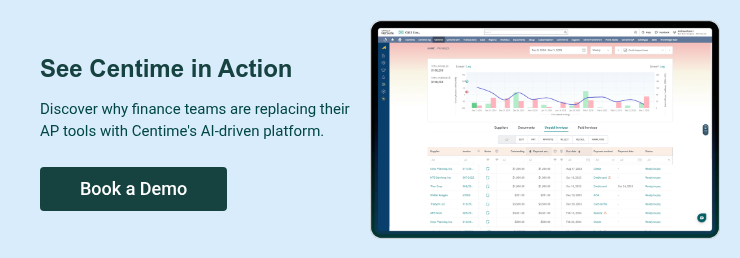
See Centime in action
Our innovative AR, AP and business banking solutions are powerful alone, and even better together.
Schedule a tailored demo with a Centime expert.
1. You’re constantly cross-referencing to meet compliance
“Our old AP system couldn't handle the complex compliance tracking required for government contracts... After one particularly stressful audit where we scrambled to piece together payment documentation from multiple spreadsheets, I realized we needed a solution that could automatically track compliance requirements and maintain detailed audit trails.”
— Josh Ladick, President, GSA Focus
2. Year-end processes take longer, even with the same team
“We hit a breaking point when processing year-end tax documents took nearly triple the time compared to previous years, despite having the same team size... We've cut our processing time by 60% and our team can focus on more strategic financial planning work.”
— Gregory Rozdeba, CEO, Dundas Wealth
3. Finance is compensating with spreadsheets
“The real red flags were recurring late payments, vendor dissatisfaction, and slower month-end closes... When the AP team began building spreadsheets and off-system trackers to compensate, it was clear the tool had outlived its purpose.”
— Rose Jimenez, CFO, Culture.org
4. Multi-currency and multi-entity workflows are breaking down
“The tipping point came when our finance team had to maintain separate spreadsheets just to track payment statuses across different countries... Our new AP system has made scaling across markets much smoother.”
— Paul Sher, CEO, FuseBase
5. The tool can’t keep up with your company’s pace
“Our old AP automation system started causing bottlenecks during peak periods—what used to take hours started taking days... Upgrading wasn’t just about fixing problems; it was aligning our tools with our growth ambitions.”
— Corina Tham, Director, CheapForexVPS
6. You can’t trust what the system is telling you about cash
“Our payable schedules didn't match what was showing in the system... we lacked real-time insights into liabilities across departments... That shift turned AP from a back-office task into a strategic lever for cash management.”
— Emily Tran, Finance Analyst, Maple Worthy
7. Internal controls and audit readiness aren’t keeping up
“Our AP system couldn't produce a clear, end-to-end audit trail for several high-value invoices... We also began to encounter issues with inconsistent invoice coding across departments, which led to GL discrepancies and wasted time.”
— Wes Lewins, CFO, Networth
8. You’re missing discounts or wasting hours on rework
“We started missing early payment discounts because approvals were getting stuck... manual data entry and error corrections were costing us roughly 25 hours per week across our team.”
— Edward Piazza, President, Titan Funding

9. Vendors are frustrated. Finance is drowning.
“Our controller flagged six duplicate payments and a week-long backlog... Vendors were annoyed. Finance felt like they were drowning in spreadsheets. An audit trail took 3 hours to reconstruct. That moment screamed ‘system failure.’”
— Mike Khorev, Managing Director, Nine Peaks Media
10. International growth is choking the system
“The moment I knew we needed an upgrade was when a retreat center's payment got delayed three weeks because the system couldn't handle multi-currency invoices... Worst, we lacked real-time cash flow visibility... I couldn't tell our financial health without digging through spreadsheets.”
— Chris Brewer, Managing Director, Best Retreats
What Do All These Signs Have in Common?
They’re not just signals that a tool is inefficient — they point to gaps that Centime is purpose-built to close.
Every story reflects a finance team hitting the same breaking point:
Their AP system wasn’t designed to scale with the complexity, visibility, and control that growing businesses need.
These leaders needed:
- True multi-entity and multi-currency support without relying on spreadsheets
- Real-time data from their ERP, not delayed syncs or disconnected exports
- Stronger audit trails, approval routing, and coding logic that adapt as teams grow
- Tighter cash control, with built-in visibility into timing, liabilities, and working capital
- A way to manage AP, AR, and cash together — not across three different systems
…it’s not just frustrating. It’s a liability.
What to Look for Instead
While each leader had a different trigger, many found themselves looking for the same things:
- Real-time sync with ERPs like NetSuite or Sage Intacct
- Built-in controls and audit trails (not retrofitted)
- AI-powered coding and approvals that scale with volume
- Integrated cash visibility, not disconnected spreadsheets
If that sounds familiar, a modern platform like Centime may be the right next step.
Centime offers AP, AR, forecasting, and embedded finance automation purpose-built for growing midmarket teams — without the need to bolt on 3+ tools just to make it all work.
👉 Ready to compare what modern AP looks like?
Book a demo to see how Centime helps finance teams scale without the rework.