
Top cash flow forecasting software in 2026 at a glance
Ten tools compared. Full G2 and Capterra ratings sit inside each review below.
| Company | Best for | Key features | Pros | Cons |
|---|---|---|---|---|
| Centime | Operational cash forecasting from live AP, AR, and banking | 13-week forecast, scenario modeling, ERP-native, AP + AR | Forecast fed by live data, connected AP and AR, unlimited users | US mid-market focus, demo-led |
| Agicap | Mid-market cash management and multi-bank forecasting | Multi-bank consolidation, cash forecasting, AP and AR modules | Real-time liquidity view, multi-entity, strong support | Costs climb with scale, setup effort |
| Float | Small-business cash flow forecasting on QuickBooks or Xero | Visual cash timeline, scenarios, QuickBooks/Xero/FreeAgent sync | Easy to use, quick setup, affordable | Small-business focus, no AP or AR execution |
| BILL | Teams already on BILL for AP and AR | AP and AR automation plus BILL Cash Flow Forecasting | AP, AR, and forecasting in one, big brand | Forecasting is a bolt-on, QuickBooks Online only |
| Tesorio | AR-driven collections plus cash flow | AI collections, payment prediction, cash analytics | Strong collections and cash flow, top ratings | AR and cash focus, no AP execution |
| HighRadius | Enterprise AR with a treasury and forecasting module | AI cash application, AR, treasury and cash forecasting | Deep enterprise AR and treasury, large ERP network | Enterprise cost and long rollout |
| Jirav | FP&A forecasting and budgeting for growing teams | 3-statement forecasting, budgeting, dashboards | Strong forecasting engine, good support | Steep learning curve, higher entry price |
| Planful | Enterprise FP&A and planning | Budgeting, forecasting, multi-entity consolidation | Deep planning and consolidation | Enterprise cost, setup complexity |
| Kyriba | Enterprise treasury and liquidity | Treasury, liquidity, cash forecasting, risk | Deep treasury and multi-bank cash visibility | Enterprise cost and implementation |
| Fathom | Small-business reporting and forecasting | Reporting, cash flow forecasting, KPIs | Easy to use, strong reporting, affordable | Reporting-first, lighter operational cash tools |
What is cash flow forecasting software?
Cash flow forecasting software projects the money coming into and going out of a business over a set horizon, so finance can see its future cash position instead of guessing from a static spreadsheet. A short operational forecast, often 13 weeks, tracks near-term liquidity for payment and collection decisions, while longer-range forecasts feed budgeting and planning. The quality of a forecast depends on its inputs: live AP, AR, and bank data produce a far more accurate picture than manual exports.
The category splits into three groups. Dedicated cash flow tools focus on short-term liquidity and scenarios, FP&A platforms handle budgeting and long-range planning, and treasury systems manage liquidity across many banks for large enterprises. Broader finance automation platforms build the forecast directly from the AP and AR they already run, so the cash view updates as invoices and payments move rather than at the next spreadsheet refresh.
Why do you need cash flow forecasting software?
Most teams forecast cash in a spreadsheet that is wrong the moment it is saved. Someone exports balances, keys in expected payments, and emails the file around, and by the time the CFO reads it, invoices have been paid and customers have slipped. That lag turns cash decisions into guesswork.
Forecasting software keeps the view current. When the forecast pulls from live AP, AR, and bank data, finance can see the exact week cash could dip and act before it does, for example drawing on a line of credit or holding a payment run. The average mid-size business is owed around $300,000 in late payments at any time, so a current view of expected inflows is money, not just a report.
The need is widespread because finance automation still lags. Only 1 percent of CFOs have automated more than three-quarters of their finance processes, according to McKinsey's 2024 CFO Pulse, and CFOs juggle 20 to 30 point-solution vendors on average, per Houlihan Lokey. A forecast connected to the systems that move cash is how teams cut both the guesswork and the tool sprawl.
Who needs cash flow forecasting software?
Cash flow forecasting software fits any team that has to answer where cash will be next week, next month, or next quarter. The right tool depends on your size, your horizon, and how your data flows.
CFOs and VPs of Finance
CFOs own cash and runway. They need a forward view they can trust in a board meeting and the ability to model what happens if a big customer pays late or a large purchase lands early.
For this buyer, a forecast fed by live data beats a static model, because the decisions riding on it, drawing credit or timing payments, depend on the numbers being current.
Controllers
Controllers tie the forecast back to actuals at close. They want a forecast that reconciles to the ledger without a manual rebuild each month.
The best cash flow management software for a controller updates from the same AP, AR, and bank data that feeds the books, so forecast and actuals do not drift apart.
FP&A and finance planning teams
FP&A teams model budgets, scenarios, and long-range plans. They need driver-based forecasting and the ability to compare plan to actual across the P&L, balance sheet, and cash flow.
For this buyer, FP&A platforms like Jirav and Planful fit the planning horizon, though they rely on imported data rather than live transactions for near-term cash.
Treasury and cash managers
Treasury teams at larger companies manage liquidity across many banks and entities. They need multi-bank cash visibility, risk management, and forecasting at scale.
Enterprise treasury systems like Kyriba fit this need, with the cost and implementation that enterprise scale implies.
Small business owners and founders
Small businesses and founders want a simple, affordable view of runway, usually on QuickBooks or Xero. The best cash flow forecasting software for small business is quick to set up and easy to read.
Tools like Float and Fathom fit here, trading the depth of an operational or enterprise system for speed and a low monthly price.
Best cash flow forecasting software: in-depth review and comparison

1. CentimeOur top pick
Best for: Operational cash forecasting from live AP, AR, and banking
Overview
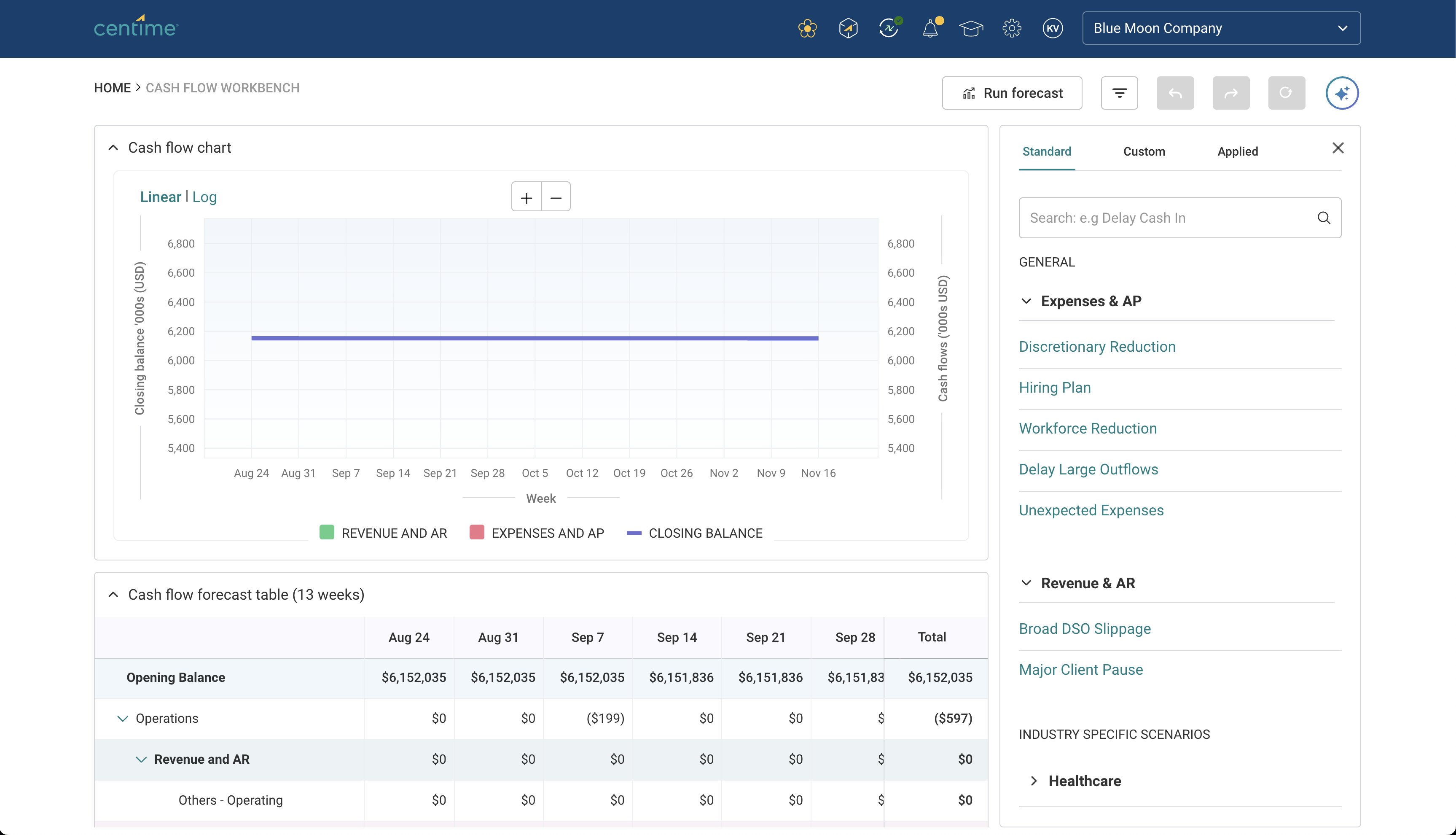
Centime is a finance automation platform whose 13-week cash flow forecasting runs on live data from its own accounts payable automation and accounts receivable automation, embedded in the ERP a company already runs. It was founded by BC Krishna, who earlier founded MineralTree. It targets US mid-market companies that want an operational cash forecast tied to real transactions, not a spreadsheet rebuilt each week.
Ideal for
- Mid-market finance teams on NetSuite, Sage Intacct, QuickBooks, or Dynamics 365 Business Central
- CFOs and controllers who want an operational forecast tied to live AP, AR, and banking
- Teams that want cash forecasting connected to the workflows that move cash, not a standalone model
Top features
- A rolling 13-week forecast built from actual and expected AP, AR, and bank data, so it reflects real transactions rather than stale exports.
- Scenario modeling that lets a CFO test what if a large customer pays 45 days late, or the team buys materials early, and see the week cash could dip.
- A Cash Plan tool that lets teams adjust payment dates, amounts, or methods and see the cash impact before committing a payment run.
- Connected treasury management and cash reporting and KPIs, so the forecast sits alongside live cash visibility.
Why we stand out
Centime is the only tool here whose forecast is fed by its own live AP and AR inside the ERP, rather than manual imports or a shallow bank feed. FP&A tools plan the long range from GL data, and dedicated cash-flow apps sync at a distance; Centime updates as invoices and payments move. Cash forecasting is included with any active AP or AR subscription, so it is not a separate purchase.
Pros
- Forecast built from live AP, AR, and bank data, not manual exports
- Connected to the AP and AR that actually move cash, with working capital and a line of credit alongside
- Native two-way ERP sync with NetSuite, Sage Intacct, Dynamics, and QuickBooks
- Unlimited users; forecasting included with an AP or AR subscription
Cons
- Built for US mid-market finance, not global enterprise treasury at massive scale
- Operational 13-week horizon rather than long-range FP&A planning
- Demo-led, so there is no instant free trial
Pricing
Consumption-based and custom-quoted, with unlimited users. Cash forecasting is included as a standard feature with any active AP or AR subscription, bought through a demo and custom quote.
Ratings
Centime holds a rating of 4.5 on G2 and is a G2 Mid-Market Leader. Reviewers praise the real-time forecast replacing error-prone weekly Excel and the connected AP and AR; the main caveat is a smaller review base than legacy tools.
Final verdict
Centime is the best cash flow forecasting software for mid-market teams that want an operational forecast tied to live AP, AR, and banking. You can book a 30-minute demo to see the forecast run on your own data.
2. Agicap
Best for: Mid-market cash management and multi-bank forecasting
Overview
Agicap is a cash management and forecasting product for mid-market companies, built around multi-bank consolidation and real-time liquidity, with AP and AR modules alongside. It is strong in Europe and expanding, and it suits multi-entity businesses that want a daily cash view across accounts.
Ideal for
- Mid-market companies with multiple bank accounts and entities
- Finance teams that want real-time liquidity consolidation
- Businesses that want cash forecasting with AP and AR modules
Top features
- Multi-bank cash consolidation
- Cash flow forecasting with scenarios
- AP and AR modules for payables and receivables
Why they stand out
Agicap is one of the strongest choices for a mid-market team that wants a consolidated, real-time cash view across many banks and entities, with forecasting built on that live data.
Pros
- Real-time, multi-bank liquidity view
- Multi-entity consolidation and forecasting
- Responsive customer success, per reviewers
Cons
- Costs climb quickly as you scale, per reviewers
- Setup can take effort
- Limited customization noted in some reviews
- AP and AR modules are lighter than dedicated tools
Pricing
Custom, quote-based pricing that scales with entities and modules. Reviewers note costs rise with usage.
Ratings
Agicap holds a rating of 4.4 on G2 and 4.3 on Capterra. Reviewers praise the intuitive interface and real-time cash visibility, while critiques cite rising cost at scale and setup effort.
Final verdict
Agicap is recommended for mid-market teams that want multi-bank cash consolidation and forecasting. For a forecast fed by deep, ERP-native AP and AR, Centime ties more tightly to the transactions that move cash.
3. Float
Best for: Small-business cash flow forecasting on QuickBooks or Xero
Overview
Float is a cash flow forecasting product for small businesses, built on top of QuickBooks Online, Xero, and FreeAgent. It presents a visual cash timeline and scenarios, and it is known for an easy transition from spreadsheets. Most of its reviews come from small businesses.
Ideal for
- Small businesses on QuickBooks Online, Xero, or FreeAgent
- Owners who want a visual, short-term cash view
- Teams moving off spreadsheet forecasts
Top features
- Visual cash flow timeline
- Scenario planning
- Sync with QuickBooks Online, Xero, and FreeAgent
Why they stand out
Float is one of the smartest choices for a small business that wants simple, visual cash flow forecasting without a heavy platform, with a quick setup on top of its accounting tool.
Pros
- Easy to use, with a quick transition from spreadsheets
- Clear visual cash timeline and scenarios
- Affordable monthly pricing
Cons
- Built for small business, not mid-market complexity
- No AP or AR execution, only forecasting
- Depends on the accounting tool for data accuracy
- Limited for multi-entity or treasury needs
Pricing
Paid monthly plans starting around $59 per month, with higher tiers for more features.
Ratings
Float holds a rating of 4.4 on G2 and 4.5 on Capterra, mostly from small businesses. Reviewers praise ease of use and the visual forecast, while critiques note it suits smaller teams more than complex finance operations.
Final verdict
Float is recommended for small businesses that want simple, visual cash flow forecasting on QuickBooks or Xero. Mid-market teams that need forecasting tied to live AP and AR will outgrow it.

4. BILL
Best for: Teams already on BILL for AP and AR
Overview
BILL (previously Bill.com) pairs its AP and AR automation with BILL Cash Flow Forecasting, an embedded feature that absorbed the Finmark technology BILL acquired. After BILL discontinued the standalone Finmark product on April 1, 2026, forecasting now lives inside BILL's subscription tiers rather than as a separate tool. It fits teams already running BILL for payments.
Ideal for
- Teams already using BILL for AP and AR
- QuickBooks Online users on BILL's Team or Corporate plans
- Small and lighter mid-market teams wanting forecasting bundled with payments
Top features
- AP and AR automation
- BILL Cash Flow Forecasting, up to a 13-month view
- QuickBooks Online sync
Why they stand out
BILL is one of the smartest choices for a team already in the BILL ecosystem that wants a forecast attached to the payments it already runs, without adding another vendor.
Pros
- AP, AR, and forecasting under one familiar brand
- Forecasting bundled into existing BILL plans
- Large installed base and QuickBooks link
Cons
- Forecasting is a bolt-on to the AP/AR product, not a dedicated tool
- Included only in Team and Corporate plans, for QuickBooks Online users
- Lost some Finmark capabilities in the transition
- Shallow ERP sync beyond QuickBooks
Pricing
BILL Cash Flow Forecasting is included in BILL's Team ($65 per user per month) and Corporate ($89 per user per month) plans for QuickBooks Online users, not the entry Essentials tier.
Ratings
BILL holds a rating of 4.4 on G2 and 4.1 on Capterra. Those reviews cover the AP and AR product broadly; the embedded forecasting feature has a small dedicated review base. Reviewers praise ease of use and QuickBooks sync, while critiques cite sync reliability and support.
Final verdict
BILL is recommended for teams already on BILL for AP and AR that want forecasting bundled in. For an operational forecast fed by live AP and AR across more ERPs, Centime fits better.
5. Tesorio
Best for: AR-driven collections plus cash flow
Overview
Tesorio is an AI-driven accounts receivable and cash flow product that automates collections, predicts payments, and manages cash performance. It is mid-market-focused and highly rated for usability, with forecasting built from its AR and payment data.
Ideal for
- Mid-market teams that want AR collections plus a cash flow view
- Finance teams focused on reducing DSO and forecasting receipts
- Companies that value payment prediction
Top features
- AI collections execution
- Payment prediction
- Cash flow and cash performance analytics
Why they stand out
Tesorio is one of the strongest choices when the cash forecast is driven mainly by receivables, pairing collections automation with payment prediction and cash analytics.
Pros
- Strong collections automation and cash flow analytics
- Top usability ratings in the category
- Payment prediction sharpens receipt forecasting
Cons
- AR and cash-flow focus, with no AP execution
- Custom pricing with no public tiers
- Forecast leans on receivables rather than full AP and AR
- No connected AP on the same platform
Pricing
Custom pricing quoted directly, with no public tiers. Demo-led.
Ratings
Tesorio holds a rating of 4.7 on G2 and 4.9 on Capterra. Reviewers praise ease of use, collections automation, and support, while critiques cite custom pricing and the absence of AP on the same platform.
Final verdict
Tesorio is recommended for mid-market teams whose cash forecast is receivables-driven. For a forecast fed by both AP and AR, Centime covers both sides of cash.
6. HighRadius
Best for: Enterprise AR with a treasury and forecasting module
Overview
HighRadius is an enterprise order-to-cash platform that pairs deep AR automation with a treasury and cash forecasting module. It serves large enterprises with complex, global cash and receivables, using AI across cash application, deductions, and forecasting.
Ideal for
- Large enterprises with complex, global cash and AR
- Teams that want AR and treasury forecasting in one suite
- Companies with multi-ERP environments and high volume
Top features
- AI cash application and AR automation
- Treasury and cash forecasting module
- Analytics across a large ERP and bank network
Why they stand out
HighRadius is one of the strongest choices for a large enterprise that wants AR and cash forecasting at scale, with one of the deepest treasury and receivables feature sets in the market.
Pros
- Deep enterprise AR plus treasury forecasting
- Large ERP and bank network
- Strong AI across the cash cycle
Cons
- Enterprise cost and long implementations
- Heavy for mid-market teams
- Forecasting is one module in a large suite
- IT dependency noted by reviewers
Pricing
Custom enterprise pricing with no public rates, often outcome-based.
Ratings
HighRadius holds a rating of 4.3 on G2 and 4.6 on Gartner Peer Insights. Its Capterra listing sits on a small sample, so the G2 and Gartner scores are the stronger signal; reviewers praise automation and visibility, while critiques cite implementation and IT dependency.
Final verdict
HighRadius is recommended for large enterprises that want AR and treasury forecasting at scale. For mid-market operational cash forecasting tied to AP and AR, it is more platform than the job requires.
7. Jirav
Best for: FP&A forecasting and budgeting for growing teams
Overview
Jirav is an FP&A product for growing teams, built for driver-based planning, 3-statement forecasting, and scenario modeling, connected to accounting systems like QuickBooks and Xero. It produces P&L, balance sheet, and cash flow forecasts for budgeting and planning.
Ideal for
- Growing teams and startups that have outgrown spreadsheets
- Accounting firms modeling multiple clients
- Finance teams that want budgeting plus forecasting
Top features
- Driver-based 3-statement forecasting
- Budgeting and budget-to-actuals
- Dashboards and reporting
Why they stand out
Jirav is one of the strongest choices when the need is FP&A planning rather than operational cash, with a well-regarded forecasting engine and strong support scores.
Pros
- Strong 3-statement forecasting engine
- Budgeting and budget-to-actuals in one tool
- Good support, per reviewers
Cons
- Steep learning curve and longer setup
- Higher entry price, with a yearly minimum
- Planning horizon rather than live operational cash
- Relies on imported data, not live AP and AR feeds
Pricing
Custom, quote-based pricing; third-party listings cite a yearly minimum around $10,000.
Ratings
Jirav holds a rating of 4.7 on G2 and 4.9 on Capterra. Reviewers praise the forecasting depth and output quality, while critiques cite the learning curve and setup time.
Final verdict
Jirav is recommended for growing teams that need FP&A forecasting and budgeting. For a near-term operational cash forecast fed by live AP and AR, it is built for a different horizon.
8. Planful
Best for: Enterprise FP&A and planning
Overview
Planful is an enterprise FP&A product for budgeting, forecasting, and multi-entity consolidation, aimed at mid-market and enterprise finance teams. It supports structured planning cycles and consolidated reporting across entities.
Ideal for
- Mid-market and enterprise companies with multiple entities
- Finance teams that need consolidated planning and reporting
- Teams running structured budgeting and forecasting cycles
Top features
- Dynamic budgeting and forecasting
- Multi-entity consolidation
- Reporting and planning templates
Why they stand out
Planful is one of the strongest choices for a larger organization that needs deep planning and multi-entity consolidation, with a mature FP&A feature set.
Pros
- Deep budgeting, forecasting, and consolidation
- Strong reporting automation
- Suited to multi-entity organizations
Cons
- Enterprise cost and setup complexity
- Learning curve for planning and consolidation
- Planning horizon rather than operational cash
- Relies on imported data for near-term cash
Pricing
Custom pricing tailored to company size, users, and modules. Quote-based.
Ratings
Planful holds a rating of 4.3 on G2 and 4.3 on Capterra. Reviewers praise reporting automation and forecasting cycles, while critiques cite setup complexity and the planning learning curve.
Final verdict
Planful is recommended for mid-market and enterprise teams that need deep FP&A planning and consolidation. For operational cash forecasting tied to live AP and AR, it is a planning platform, not a cash tool.
9. Kyriba
Best for: Enterprise treasury and liquidity
Overview
Kyriba is an enterprise treasury and liquidity product that manages cash, payments, risk, and forecasting across many banks and entities. It is built for large, complex organizations and is a reference point for enterprise treasury, including in Centime's own positioning.
Ideal for
- Large enterprises with complex, multi-bank treasury needs
- Treasury teams managing liquidity and risk at scale
- Companies that need global cash visibility and payments
Top features
- Treasury and liquidity management
- Multi-bank cash visibility and forecasting
- Payments and risk management
Why they stand out
Kyriba is one of the strongest choices for enterprise treasury, with deep multi-bank cash visibility and forecasting that few tools match at the top of the market.
Pros
- Deep enterprise treasury and liquidity
- Multi-bank cash visibility and forecasting
- Payments and risk in one suite
Cons
- Enterprise cost and long implementation
- Heavy for mid-market finance teams
- Treasury focus rather than AP and AR execution
- Requires dedicated treasury resources
Pricing
Custom enterprise pricing with no public rates. Quote-based, with an implementation program.
Ratings
Kyriba holds a rating of 4.5 on G2 and 4.4 on Capterra. Reviewers praise centralized cash management and multi-bank visibility, while critiques cite implementation effort and the cost of enterprise treasury.
Final verdict
Kyriba is recommended for large enterprises that need treasury-grade liquidity management. For a mid-market operational cash forecast without an enterprise treasury program, Centime delivers the forecast at a fraction of the cost.
10. Fathom
Best for: Small-business reporting and forecasting
Overview
Fathom is a reporting and forecasting product for small businesses and advisory firms, built on top of QuickBooks and Xero. It is known for clear, customizable reporting and KPIs alongside cash flow forecasting, and it is easy to adopt.
Ideal for
- Small businesses that want reporting plus forecasting
- Accounting and advisory firms serving multiple clients
- Owners who want clear financial reports and a cash view
Top features
- Customizable financial reporting
- Cash flow forecasting
- KPI tracking and analysis
Why they stand out
Fathom is one of the smartest choices for a small business or advisory firm that wants strong reporting with a cash flow forecast attached, with an easy setup and clear output.
Pros
- Easy to use, with strong reporting
- Cash flow forecasting and KPIs
- Affordable and quick to adopt
Cons
- Reporting-first, lighter on operational cash tools
- Built for small business and advisory, not mid-market complexity
- No AP or AR execution
- Depends on the accounting tool for data
Pricing
Paid monthly plans starting at an affordable entry price.
Ratings
Fathom holds a rating of 4.6 on G2 and 4.6 on Capterra. Reviewers praise ease of use and customizable reporting, while critiques note it is reporting-led rather than an operational cash tool.
Final verdict
Fathom is recommended for small businesses and advisory firms that want reporting plus a cash forecast. For an operational forecast fed by live AP and AR, it covers a lighter use case than Centime.
How to choose the best cash flow forecasting software
Decide operational or long-range
First decide what the forecast is for. A short operational forecast, around 13 weeks, drives near-term payment and collection decisions, while a long-range forecast feeds budgeting and planning. Operational cash tools and FP&A platforms are built for different horizons, so match the tool to the question you are answering.
Many teams need both, but the near-term, decision-driving forecast is where live data matters most.
Check how it pulls data
The accuracy of a forecast comes from its inputs. Tools that pull from live AP, AR, and bank feeds stay current as money moves, while those that rely on manual imports are only as fresh as the last upload. Ask each vendor exactly where the numbers come from and how often they refresh.
A forecast built from the systems that actually move cash, like accounts payable automation and AR, reflects reality, not last week's export.
Weigh ERP and bank integration
Deep integration decides how much manual work the forecast takes to maintain. Prioritize tools with native two-way sync to your ERP, through native NetSuite integration, Sage Intacct, or QuickBooks, and multi-bank connectivity for cash positions.
Shallow integration means you rebuild the forecast by hand, which is the problem you are trying to escape.
Match the tool to your size
Small businesses are well served by affordable tools like Float and Fathom. Mid-market teams need forecasting tied to AP and AR, and enterprises need treasury-grade liquidity across many banks, where Kyriba and Planful fit.
Buying enterprise treasury you do not need is cost and complexity you still pay for, so size the tool to the team.
Look for scenario modeling and connected cash
A forecast is most useful when you can model scenarios and act on them. Look for the ability to test late payments or large purchases and see the cash impact, ideally connected to the levers that change it, like payment timing and collections.
Centime's Cash Plan, for example, lets teams adjust a payment run and see the forecast move before they commit.
Everything you need to know about cash flow forecasting software
Ratings below are editorial, grounded in each tool's G2 and Capterra ease-of-use and support subscores and its pricing model.
| Company | Top pros | Top cons | Ease of use | Integrations | Support | Affordability |
|---|---|---|---|---|---|---|
| Centime | Forecast from live AP/AR/bank, connected, unlimited users | Mid-market US focus, 13-week horizon | 4/5 | 5/5 | 5/5 | 4/5 |
| Agicap | Real-time multi-bank view, multi-entity | Costs climb, setup effort | 4/5 | 4/5 | 4/5 | 3/5 |
| Float | Easy, visual, affordable | SMB only, no AP/AR execution | 5/5 | 4/5 | 4/5 | 4/5 |
| BILL | AP, AR, and forecasting in one | Bolt-on forecasting, QBO only | 4/5 | 4/5 | 3/5 | 3/5 |
| Tesorio | Collections plus cash flow, top usability | No AP, receivables-led forecast | 5/5 | 4/5 | 5/5 | 3/5 |
| HighRadius | Deep enterprise AR plus treasury | Enterprise cost, long rollout | 4/5 | 5/5 | 4/5 | 2/5 |
| Jirav | Strong FP&A forecasting engine | Learning curve, higher entry price | 3/5 | 4/5 | 4/5 | 3/5 |
| Planful | Deep planning and consolidation | Enterprise cost, setup complexity | 3/5 | 4/5 | 4/5 | 2/5 |
| Kyriba | Enterprise treasury, multi-bank cash | Enterprise cost and rollout | 3/5 | 5/5 | 4/5 | 2/5 |
| Fathom | Easy, strong reporting, affordable | Reporting-first, lighter cash tools | 5/5 | 4/5 | 5/5 | 4/5 |
Forecast cash with Centime
Centime is the best cash flow forecasting software for mid-market teams because its 13-week forecast is built from live AP, AR, and bank data inside your ERP, so it reflects real transactions instead of a spreadsheet someone rebuilt last Tuesday. You can model a late payment or an early purchase, see the week cash could dip, and adjust a payment run before you commit, with unlimited users and forecasting included in an AP or AR subscription.
If your cash forecast lives in a spreadsheet that is wrong by the time you read it, that is the gap Centime closes. See the Centime vs Tesorio comparison or the Centime vs BILL comparison if you are weighing options, read how to build a 13-week cash flow forecast, or book a demo. Most customers are live in 7 to 21 days.

FAQs about cash flow forecasting software
What is the best cash flow forecasting software in 2026?
The best cash flow forecasting software in 2026 is Centime for mid-market finance teams, because its rolling 13-week forecast is built from live AP, AR, and bank data inside NetSuite, Sage Intacct, Dynamics 365 Business Central, or QuickBooks. Float and Fathom are the best affordable picks for small business, Agicap leads for multi-bank mid-market cash management, and Kyriba fits enterprise treasury. The right choice depends on your horizon, your data sources, and your size. For an operational forecast tied to the transactions that move cash, Centime is the strongest overall.
What should I consider when choosing the right cash flow forecasting software for me?
Choosing the right cash flow forecasting software starts with your horizon, your data sources, your ERP, and your size. Decide whether you need a near-term operational forecast or long-range FP&A planning, then prioritize tools that pull from live AP, AR, and bank feeds rather than manual imports. Confirm native integration for your ERP and multi-bank connectivity, and match the tool to your scale, from affordable small-business apps to enterprise treasury. Look for scenario modeling you can act on, and model the all-in cost before you decide.
How does Centime differ from similar alternatives?
Centime differs from similar alternatives by building its 13-week forecast from its own live AP and AR inside your ERP, where FP&A tools plan from imported GL data and dedicated cash-flow apps sync at a distance. It connects the forecast to the levers that change cash, payment timing and collections, through a Cash Plan tool. Pricing is consumption-based with unlimited users, and forecasting is included with any AP or AR subscription. That live, connected data is why its forecast stays current as money moves.
How do I get started with Centime?
Getting started with Centime begins with a 30-minute demo, where you see the forecast run on your own AP, AR, and bank data. Onboarding then runs 7 to 21 days with a dedicated specialist, and the QuickBooks, NetSuite, and Sage Intacct integrations are turnkey. Cash forecasting is included with any active AP or AR subscription, so most teams start with a workflow and the forecast comes with it. There is no need to switch banks or replace your ERP.
How easy is it to switch to Centime?
Switching to Centime is straightforward, and most customers are live within 7 to 21 days with a dedicated onboarding specialist. Because the forecast is built from Centime's own AP, AR, and bank data, you do not maintain a separate model or re-import balances each week. The QuickBooks, NetSuite, and Sage Intacct integrations are turnkey, and there is no need to switch banks. Teams replace error-prone weekly spreadsheets with a forecast that updates as transactions post.
Is cash flow forecasting software worth it for small business?
Cash flow forecasting software is worth it for small business when runway and timing decisions start riding on a spreadsheet that goes stale, and affordable tools like Float and Fathom make it accessible from around $44 to $59 per month. The best cash flow forecasting software for small business connects to QuickBooks or Xero and is quick to set up. The trade-off is depth: small-business tools forecast well but do not run the AP and AR that move cash. Teams scaling fast often move to a connected platform like Centime so the forecast draws on live payables and receivables.
What is the difference between cash flow forecasting and FP&A software?
The difference between cash flow forecasting and FP&A software is horizon and purpose: cash flow forecasting projects near-term liquidity, often 13 weeks, to drive payment and collection decisions, while FP&A software like Jirav and Planful handles budgeting, long-range planning, and consolidation. Operational cash tools pull from live AP, AR, and bank data; FP&A tools model from GL and driver-based inputs. Many finance teams use both, one for near-term cash and one for annual planning. A platform like Centime focuses on the operational forecast, built from the transactions that move cash.