
Managing AP for multiple entities shouldn't require choosing between automation speed and reporting quality. Yet 39.56% of companies take 3-6 days to consolidate their entities, while another 24.18% require 7-10 days. During this lag, executives make decisions based on incomplete or outdated data.
This guide shows controllers how to structure AP automation around Sage Intacct's dimensional architecture for faster processing and better multi-entity reporting.
Why Intacct's Dimensional Ledger Changes Everything
Traditional accounting systems create massive chart of accounts structures. A hypothetical organization with 300 accounts, 5 business units, and 10 departments requires 15,000 accounts (300 x 5 x 10). Adding one business unit adds 3,000 more accounts.
Sage Intacct's dimensional approach eliminates this multiplication by treating location, department, project, and other tracking as independent dimensions that intersect at the transaction level. This matters for AP automation because diverse systems that don't work well together create significant hurdles as entities operate on different accounting systems, introducing inefficiencies and data consolidation errors.
The financial stakes are clear: companies using limited automation spend an average of $8.78 per invoice versus $1.77 with high automation. But cost per invoice only tells part of the story.
When dimensional coding is wrong or inconsistent, consolidation takes forever, 39% of invoices contain errors that multiply during close, and you can't answer basic cross-entity questions without multi-day Excel projects.
Structuring Dimensions for Multi-Entity AP
The first decision: which dimensions belong at header versus line level. Header-level dimensions (entity/location, vendor, invoice date, default department) apply to entire invoices and streamline routine processing. Line-level dimensions (GL account, department when different from header, project/class, custom dimensions) handle complexity like shared services and multi-department purchases.
For Sage Intacct multi-entity setups, the subsidiary field becomes mandatory for invoice posting and auto-coding. When connecting to top-level during onboarding, the Location column includes both entities and locations, giving flexibility in organizational structure.
See Centime in action
Our innovative AR, AP and business banking solutions are powerful alone, and even better together.
Schedule a tailored demo with a Centime expert.
Auto-Coding That Understands Hierarchy
Generic auto-coding learns patterns but doesn't understand relationships—a problem in multi-entity environments where context determines validity.
Centime's dimensional auto-coding predicts the subsidiary based on previously posted invoices from the same supplier, automatically selecting when only one subsidiary applies. This prevents the most common error: routing invoices to wrong entities.
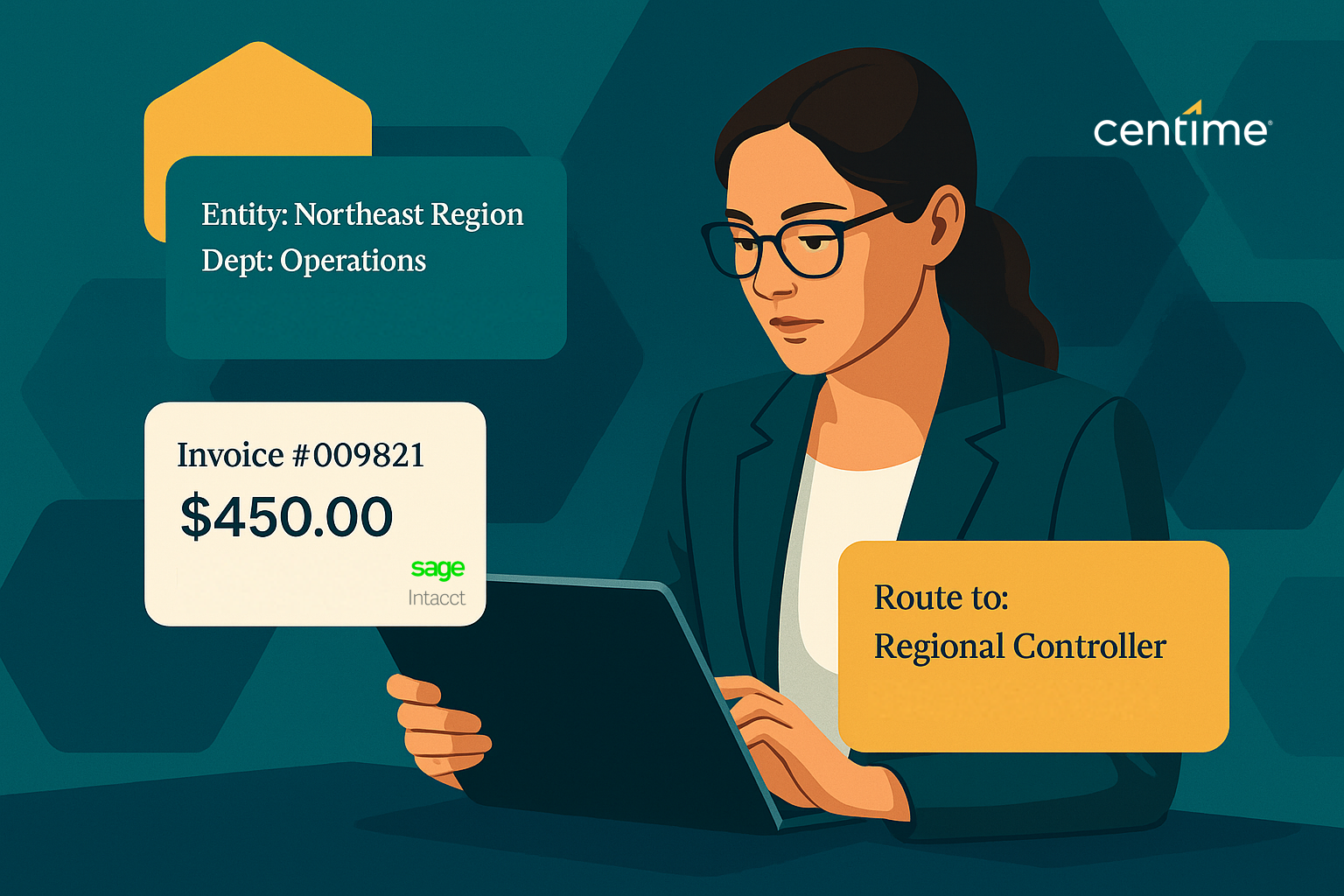
Hierarchical validation eliminates impossible combinations. If an invoice is coded to the Northeast entity, the system won't suggest departments or projects that don't exist there. This catches errors before posting rather than during reconciliation.
The learning improves over time using supplier-subsidiary combinations from historical data. For complex setups, you can teach the system your organization's specific patterns. This matters because people spend 37% of their time making decisions, with more than half spent ineffectively. Auto-coding that respects dimensional hierarchies reduces wasted time by presenting only valid options.
Entity-Specific Approval Routing
Standard workflow tools treat approval routing simplistically. Multi-entity finance requires nuance—a VP of Operations approving large purchases across all entities while regional controllers handle routine invoices for their entities.
The two biggest AP team issues are slow invoice approvals (47%) and high exceptions to invoicing standards (45%). Dimensional-aware routing addresses both by ensuring invoices reach the right approver immediately.
Build approval matrices that scale: "Route to Regional Controller if Entity = West AND Amount > $5,000 AND Department = Operations" or "Auto-approve if Vendor = [Approved List] AND Amount < $1,000." Invoices can auto-post once approved, but only if approval routing respected your dimensional structure first.
Visibility Throughout the Invoice Lifecycle
Dimensional data shouldn't only appear after posting. You need pre-posting visibility across all AP tabs—Documents for approval tracking, Unpaid Invoices for payment planning, Posted Invoices for reconciliation—to catch errors early and make informed cash decisions.
32% of CFOs say real-time data is the most important feature they look for in accounting software. This means cash forecasting by dimension to manage liquidity at the right granularity, dimensional spend analysis without Excel exports, and vendor performance analysis at entity level where patterns actually appear.
Critical Multi-Entity Capabilities
Inter-company transaction handling: Exclude inter-company customers and vendors from operational metrics while maintaining audit trails. These shouldn't inflate Days Payable Outstanding or skew vendor concentration metrics.
PO matching complexity: Centime supports full 3-way PO matching for Sage Intacct, handling scenarios where POs created by one entity cover items coded to different entities at line level. Enhanced PO line linking includes item code and receipt date to guide matching when dimensional coding differs between PO and invoice. Over 30% of PO discrepancies stem from manual processing, which dimensional-aware matching reduces.
Multi-currency operations: Centime supports seamless invoice processing for multi-subsidiary users in different currencies with accurate exchange rate calculation. The strategic decision: convert at invoice date, posting date, or use ERP rates? Support both local currency and functional currency views for different analytical purposes.
Period management: Different entities often have different fiscal calendars. Your system must respect entity-specific period locks while processing efficiently. Users receive alerts when invoice dates don't match posting periods, catching errors before they require journal entries.
See Centime in action
Our innovative AR, AP and business banking solutions are powerful alone, and even better together.
Schedule a tailored demo with a Centime expert.
Custom Dimensions and Implementation
Most mid-market Intacct users track custom dimensions beyond standard fields—property codes, equipment assets, funding sources, customer types. Your AP automation must support these in auto-coding logic, approval routing rules, filtering, and reporting with the same sophistication as standard dimensions.
Sage Intacct users can customize which GL accounts appear in Centime to reduce errors. Apply this principle to all dimensions—filtered lists based on dimensional context prevent mistakes.
Implementation approach: Start with one complex entity as pilot to refine dimensional coding rules, approval workflows, and reporting before expansion. Map historical coding patterns first since the auto-coding framework relies on supplier-subsidiary combinations from historical data.
Plan for exceptions. Multi-entity environments generate more because of inter-company transactions, shared services, and cross-entity projects. Clear documentation should cover coding authority, shared service allocations, new vendor processes, and invoice-splitting protocols.
AP automation drives 70-80% time savings, but benefits appear gradually as the system learns patterns and users adapt to dimensional workflows. Typical multi-entity implementation spans 6 months from pilot to full rollout, with continuous optimization afterward.
Measuring Success
Track efficiency metrics (time from receipt to posting by entity, auto-coding accuracy, approval cycle time by dimension, reduction in posting errors) and reporting quality metrics (questions answered without Excel, dimensional accuracy of posted invoices, finance team confidence in dimensional data, reduction in period-end reclassification entries).
Top organizations process invoices in 2.8 days versus weeks for slower peers. Set this as your target, measuring separately by entity to identify which need process improvements.
Common Pitfalls
Avoid over-engineering dimension requirements—every additional required dimension slows processing. Be ruthless about what's necessary versus nice-to-have. You can add dimensions later; removing requirements after user training is painful.
Ensure consistent vendor setup across entities. The same vendor with different names or codes breaks auto-coding and muddles spend analysis. Establish vendor master data governance early.
Design approval workflows that scale. A workflow handling 50 invoices monthly might collapse at 500. Use threshold-based routing and dimensional filtering to prevent approval bottlenecks.
Respect different entity month-end close timelines. Your automation must enable different schedules while supporting corporate consolidation on time.
See Centime in action
Our innovative AR, AP and business banking solutions are powerful alone, and even better together.
Schedule a tailored demo with a Centime expert.
The Bottom Line
Sage Intacct's dimensional ledger is powerful, but that power only translates to better decisions if your AP automation preserves and leverages dimensional data throughout the invoice lifecycle.
Structure dimensions to match how your business operates, automate coding and routing based on dimensional logic, and deliver reporting that answers real questions without manual manipulation. When you get this right, finance teams stop viewing AP automation as a necessary evil creating reporting headaches and start seeing it as a tool generating better data while saving time.
For more on Centime's approach to dimensional AP automation for Sage Intacct, visit our Sage Intacct AP integration page or book a demo today.
See Centime in action
Our innovative AR, AP and business banking solutions are powerful alone, and even better together.
Schedule a tailored demo with a Centime expert.