
.png)
Last quarter, your Northeast subsidiary needed $247,000 worth of inventory from your Southwest location. Simple internal transfer, right? Except your AP manager spent three days reconciling why the purchase order in one entity didn't match the sales order in another. The invoice sat in limbo while finance tracked down quantity discrepancies. Your intercompany payables and receivables were off by $18,000, delaying month-end close.
This scenario plays out constantly in NetSuite environments with multiple subsidiaries. Research from The Hackett Group found that 64% of organizations handling intercompany transactions cite "timely agreement with counterparties" as their biggest bottleneck. Manual reconciliation processes can extend financial close by 7-10 days according to industry data, creating reporting delays and audit pressure.
Why Intercompany Transactions Break Down in NetSuite
NetSuite handles the core intercompany mechanics reasonably well through its Automated Intercompany Management feature. When you create a purchase order in one subsidiary with a vendor that represents another subsidiary, NetSuite can generate the corresponding sales order automatically. The system tracks both sides of the transaction through paired intercompany relationships, which should theoretically keep everything aligned.
But the AP workflow is where things fall apart. When the selling subsidiary sends an invoice, your AP team needs to verify the invoice matches the original PO across entities, confirm quantities received match quantities ordered, validate pricing hasn't changed between PO creation and billing, match line items precisely (often across different item descriptions), route through appropriate approval chains in the buying entity, and post the bill while ensuring the PO status updates correctly.
Each of these steps typically happens manually. Your AP clerk is switching between NetSuite screens, comparing PDFs to system records, and chasing down approvals via email. According to IOFM benchmarking data, manual invoice processing takes an average of 12 minutes per invoice, but intercompany transactions often take twice as long due to the complexity of cross-entity matching.
See Centime in action
Our innovative AR, AP and business banking solutions are powerful alone, and even better together.
Schedule a tailored demo with a Centime expert.
The Real Cost: Delayed Closes and Reconciliation Chaos
Here's what actually happens when intercompany AP workflows remain manual:
Your month-end close gets pushed back because intercompany balances don't reconcile. One entity shows $500K payable while the other shows $482K receivable. Finance scrambles to find the $18K difference, digging through dozens of transactions to identify which invoices were posted in one system but not matched properly in the other. Research from Prophix shows that 94% of finance teams still rely on Excel for month-end close, with 50% citing it as the main reason for delays.
Your Days Sales Outstanding (DSO) metrics look worse than they should because internal transactions inflate your receivables aging. The selling subsidiary is waiting for payment from an internal entity that's stuck in approval workflows, skewing your cash conversion cycle.
Auditors flag intercompany transaction timing as a concern. When the selling entity posts revenue in December but the buying entity doesn't record the expense until January, you've got consolidation issues that create additional audit work and potential restatements.
See Centime in action
Our innovative AR, AP and business banking solutions are powerful alone, and even better together.
Schedule a tailored demo with a Centime expert.
How Automated PO Matching Actually Works for Intercompany Transactions
The fix isn't just scanning invoices faster. It's building intelligence into the matching process specifically for intercompany flows.
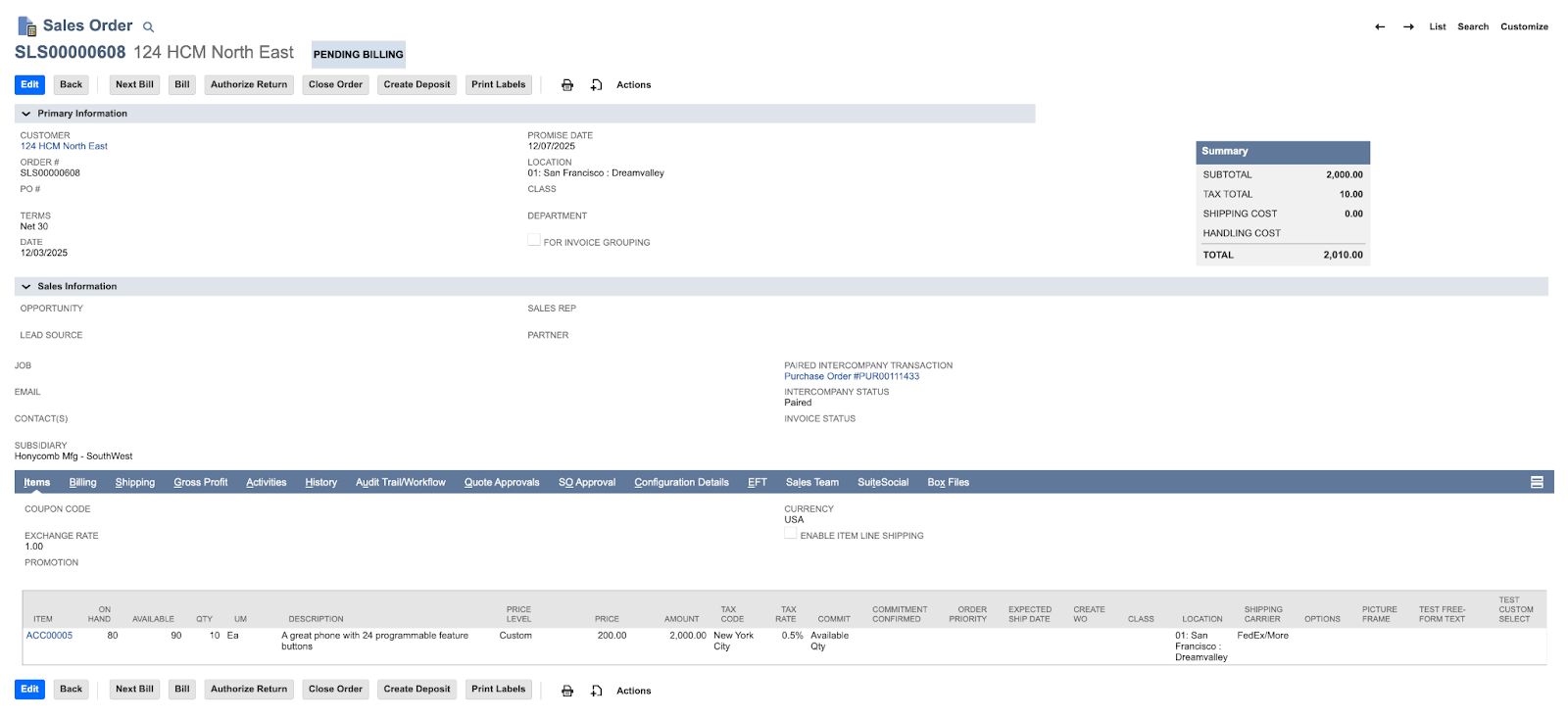
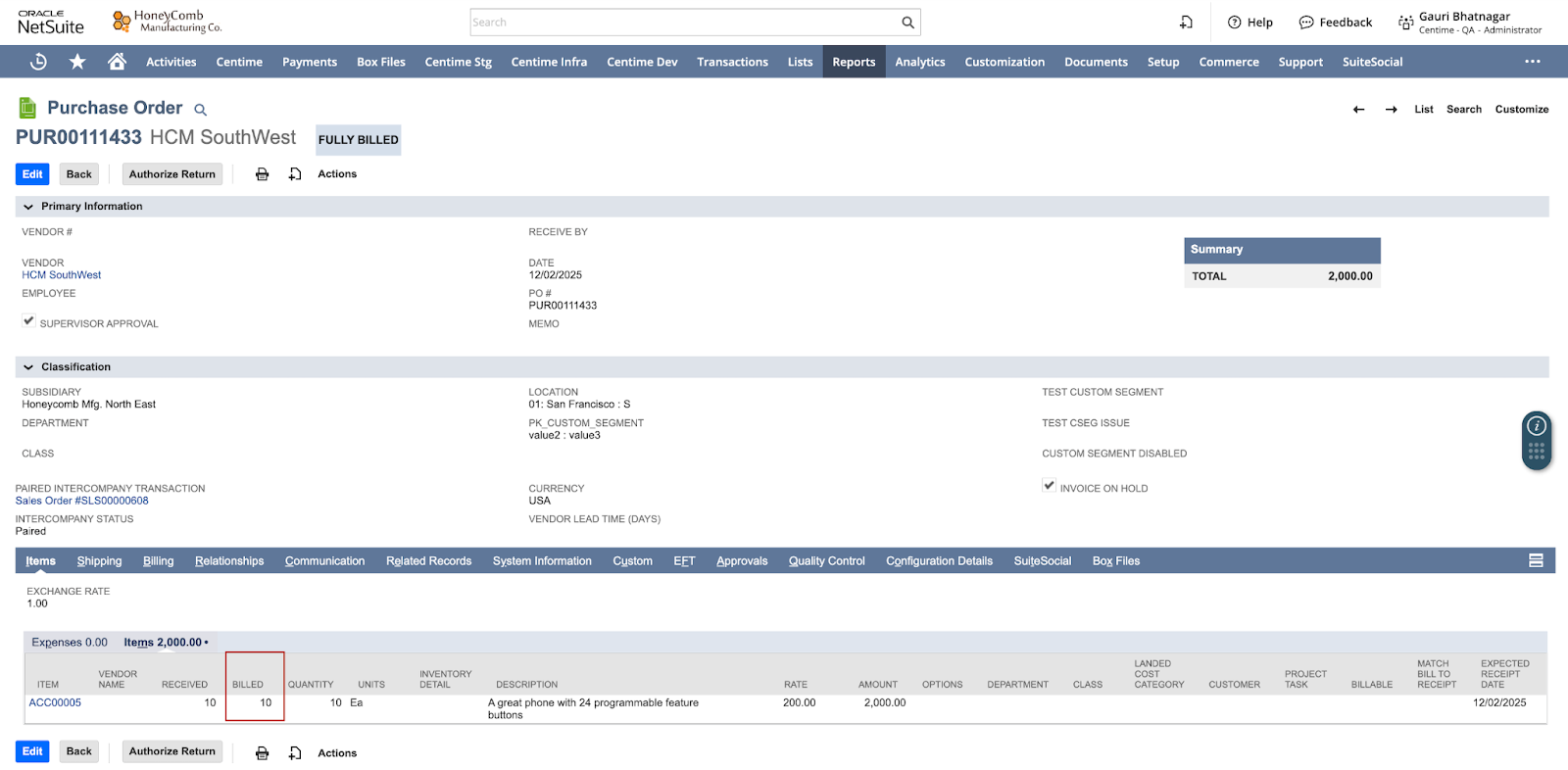
Start with proper NetSuite setup. Each vendor record should clearly represent a subsidiary through the "Represents Subsidiary" field, as outlined in NetSuite's intercompany documentation. This enables NetSuite to automatically link purchase orders and sales orders as paired intercompany transactions. When you generate Sales Order #SLS00000608 from Purchase Order #PUR00111433, NetSuite maintains that relationship.
The workflow then becomes:
Sales order fulfillment: Your Southwest subsidiary fulfills the order, moving it from Pending Fulfillment to Pending Billing status. The paired purchase order in the Northeast subsidiary automatically moves from Pending Receipt to Pending Billing once received.
Invoice capture with context: When the selling subsidiary generates an invoice, it gets uploaded into your AP automation platform with the intercompany vendor and related PO already identified. This is where most manual processes lose the thread, because someone has to manually look up which PO corresponds to which invoice across entities.
Automated line-level matching: The system compares invoice line items directly against the PO that's already linked through the intercompany relationship. Quantities, prices, item descriptions, and total amounts get validated automatically. Any discrepancies surface immediately with specific details about what doesn't match.
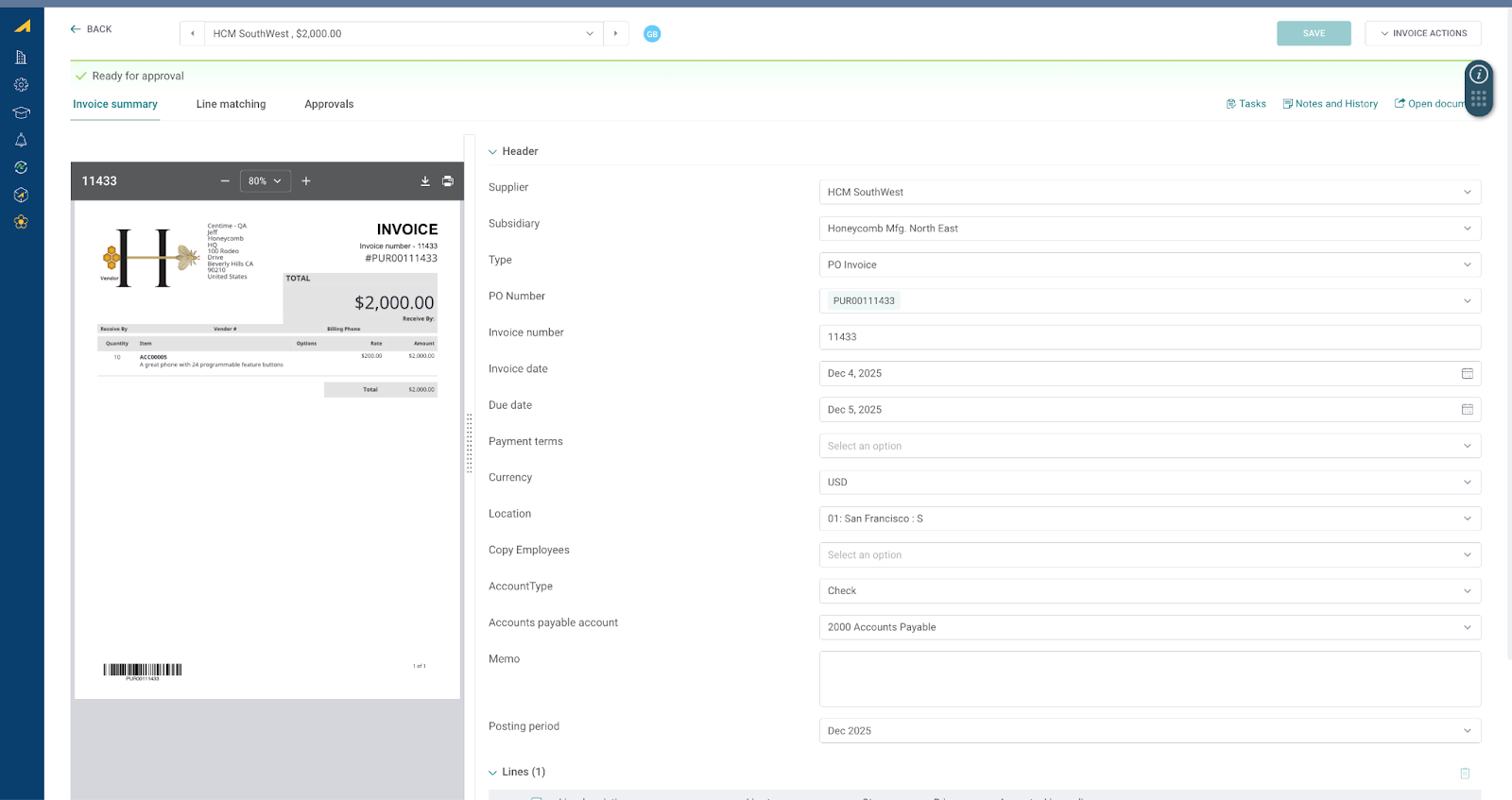
Single-click posting: After approval, posting the invoice creates the bill in NetSuite and automatically updates the PO status from Pending Billing to Fully Billed. Both sides of the intercompany transaction update simultaneously, maintaining balance between entities.
What Changes When You Automate This Process
Finance teams using automated intercompany workflows report specific improvements that directly impact their month-end close timeline.
Month-end close happens 3-5 days faster because intercompany reconciliation takes hours instead of days. You're not hunting for missing invoices or unmatched transactions because the system maintained linkage throughout the entire workflow. According to Trintech's research on intercompany accounting, organizations that automate their intercompany processes have been able to reduce write-offs from reconciliations by up to 62%.
Exception handling becomes manageable. Instead of every intercompany invoice requiring manual verification, you only touch transactions with actual discrepancies. A price change or quantity mismatch gets flagged automatically with specific details, so resolution happens quickly.
Your consolidation accuracy improves because transactions post to both entities simultaneously. There's no timing gap where revenue is recognized in one subsidiary before the expense posts in another. NetSuite's intercompany accounts documentation emphasizes that maintaining this timing alignment is critical for accurate consolidated financial statements and proper elimination of intercompany balances.
Audit trails become comprehensive without extra work. Every intercompany transaction has a complete history showing the linked PO, matching details, approval chain, and posting records across both entities. When auditors ask about specific intercompany transactions, you're pulling reports, not reconstructing paper trails.
See Centime in action
Our innovative AR, AP and business banking solutions are powerful alone, and even better together.
Schedule a tailored demo with a Centime expert.
The Setup Requirements Nobody Mentions
You can't just flip a switch and automate intercompany workflows. The prerequisite work matters.
Your vendor master data needs to be clean. Every vendor that represents a subsidiary must have the "Represents Subsidiary" field populated correctly and consistently. If you've got 15 subsidiaries and some vendor records are set up properly while others aren't, automation breaks down.
Intercompany sales order generation should follow NetSuite's best practice: create the PO first, then go to Transactions > Sales > Manage Intercompany Sales Orders, select the PO, and generate the paired sales order. This maintains the link that makes automated matching possible.
Your approval workflows need to account for intercompany nuances. A $10,000 purchase from an external vendor might require VP approval, but a $10,000 intercompany transfer between subsidiaries might follow different approval rules. Build these distinctions into your automation logic.
Item master alignment across subsidiaries prevents matching failures. If your Southwest subsidiary lists "Widget-A" but your Northeast subsidiary expects "Widget-Model-A" in the purchase order, automated matching will flag it as a discrepancy even though it's the same item. Standardize item codes and descriptions across entities before automating.
See Centime in action
Our innovative AR, AP and business banking solutions are powerful alone, and even better together.
Schedule a tailored demo with a Centime expert.
For Finance Teams Running Multiple Subsidiaries
If you're processing more than 50 intercompany transactions per month and your current workflow involves manual PO matching, you're spending roughly 40-60 hours per month on work that can run automatically. That's time your AP team could spend resolving actual exceptions or handling external vendor issues that require human judgment.
The ROI calculation is straightforward. Manual invoice processing costs between $12-$15 per invoice when you factor in labor, errors, and hidden costs. Intercompany transactions typically double that cost due to cross-entity complexity. Automated workflows drop processing costs to $2-$3 per transaction. At 200 monthly intercompany transactions, you're looking at $2,000-2,600 in monthly savings, plus the intangible benefit of closing your books faster.
Current Centime customers can implement intercompany PO-to-bill workflows by working with your Customer Success Manager to configure vendor relationships and matching rules specific to your subsidiary structure. Most implementations take 2-3 weeks depending on subsidiary count and item master complexity.
See Centime in action
Our innovative AR, AP and business banking solutions are powerful alone, and even better together.
Schedule a tailored demo with a Centime expert.
If you're not yet using Centime, schedule a demo to see how automated intercompany workflows integrate with your existing NetSuite environment. Bring your actual intercompany transaction volume, subsidiary structure, and current month-end close timeline so we can model specific improvements for your situation.
The goal isn't just faster processing. It's reducing the friction that turns routine intercompany transactions into month-end bottlenecks, giving your finance team visibility and control over what should be the most predictable part of your AP process.
See Centime in action
Our innovative AR, AP and business banking solutions are powerful alone, and even better together.
Schedule a tailored demo with a Centime expert.